

Managing dietary restrictions is now a daily part of life for nearly half of adults in the US. That might sound overwhelming as so many foods seem off-limits and complicated meal plans keep piling up. The shock is that AI-powered meal planners can now generate personalized diets in seconds and the smartest strategies for 2025 may actually make eating with restrictions easier than ever before.
Table of Contents
- Understanding Common Dietary Restrictions
- Personalized Strategies For Success
- Tracking Nutrition And Wellness Progress
- Science-Backed Supplements For Restricted Diets
Quick Summary
| Takeaway | Explanation |
|---|---|
| Understand dietary restriction types | Recognize the motivations behind different dietary restrictions, such as medical, ethical, and religious factors. |
| Leverage technology for meal planning | Utilize AI-driven meal planners to create customized diets that meet individual nutritional needs effectively. |
| Track nutrition progress diligently | Use digital tools to monitor dietary intake, helping to identify patterns and make informed food decisions. |
| Address micronutrient deficiencies proactively | Research common deficiencies linked to dietary restrictions and consider targeted supplementation strategies to mitigate risks. |
| Adopt personalized supplementation approaches | Implement unique strategies for nutrient intake based on individual health profiles and dietary constraints for optimal health. |
Understanding Common Dietary Restrictions
Dietary restrictions have become increasingly complex in modern nutrition, reflecting diverse health needs, ethical choices, and medical requirements. Understanding these different approaches helps individuals make informed nutritional decisions and manage their personal health effectively.
Types of Dietary Restrictions and Their Core Motivations
Dietary restrictions emerge from multiple sources, including medical conditions, personal health goals, cultural practices, and ethical considerations. The Dietary Guidelines for Americans highlight the importance of recognizing individual nutritional needs and developing personalized eating strategies.
Some primary categories of dietary restrictions include:
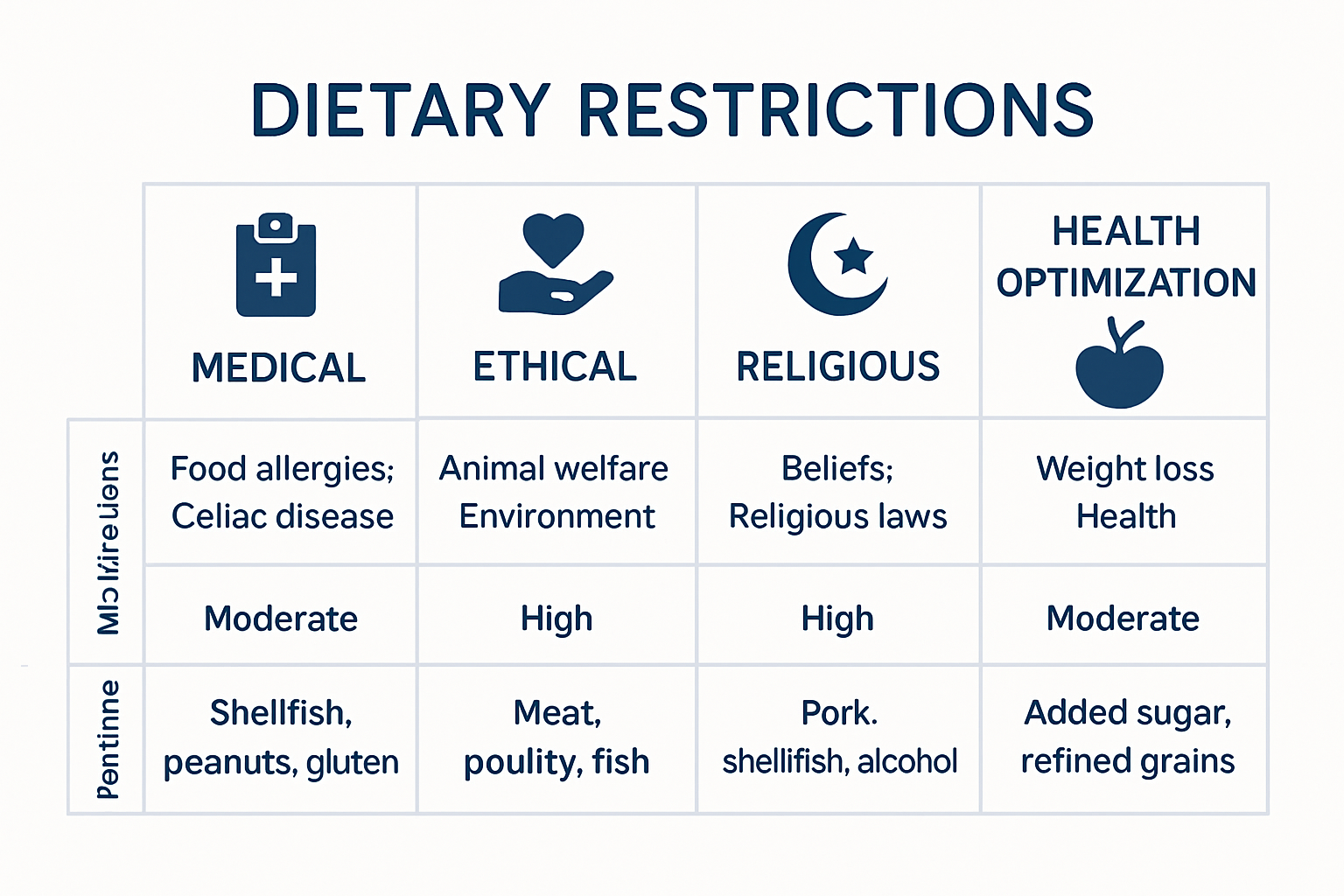
- Medical Restrictions: Conditions like celiac disease, diabetes, and food allergies require specific dietary modifications
- Ethical Choices: Vegetarian and vegan diets driven by animal welfare and environmental concerns
- Religious Practices: Kosher, halal, and other faith-based dietary guidelines
- Health Optimization: Low-sodium, low-carbohydrate, and other targeted nutritional approaches
Navigating Nutritional Challenges
Research from MedicineMet indicates that managing dietary restrictions requires comprehensive understanding and strategic planning. Each restriction presents unique nutritional challenges that demand careful consideration of nutrient intake, food alternatives, and balanced meal planning.
For individuals with specific dietary needs, key strategies include:
- Comprehensive nutrition education
- Consulting healthcare professionals
- Exploring diverse food alternatives
- Maintaining nutritional balance
- Monitoring personal health metrics
Impact on Overall Health and Wellness
The 2010 Dietary Guidelines emphasize that dietary restrictions, when managed correctly, can significantly contribute to individual health optimization. Proper implementation involves understanding nutritional requirements, identifying potential deficiencies, and developing personalized strategies that support long-term wellness.
Successful management of dietary restrictions requires a holistic approach that considers individual metabolic needs, lifestyle factors, and personal health goals. By embracing informed nutritional choices, individuals can transform dietary limitations into opportunities for enhanced health and vitality.
To clarify the main motivations for dietary restrictions, the following table summarizes the primary types and what typically drives each approach.
| Type of Dietary Restriction | Primary Motivation |
|---|---|
| Medical Restrictions | Manage specific health conditions (e.g., celiac disease, diabetes, allergies) |
| Ethical Choices | Support animal welfare and/or environmental concerns (e.g., vegetarian, vegan) |
| Religious Practices | Adhere to faith-based dietary laws (e.g., kosher, halal) |
| Health Optimization | Target improved health outcomes (e.g., low-sodium or low-carb diets) |
Personalized Strategies for Success
Navigating dietary restrictions requires more than just understanding limitations. Success depends on developing personalized strategies that transform challenges into opportunities for optimal health and wellness.
Advanced Technological Solutions for Dietary Management
Research from JMIR Formative Research reveals groundbreaking developments in AI-powered meal planning technologies. These advanced systems utilize semantic reasoning, fuzzy logic, and multicriteria analysis to generate highly personalized meal plans. By integrating comprehensive nutritional knowledge bases with individual health profiles, these technologies can create flexible dietary strategies that precisely address unique nutritional needs.
Key technological innovations in personalized dietary management include:
- AI-Driven Meal Planning: Intelligent systems that generate customized nutrition recommendations
- Genetic Nutritional Profiling: Utilizing genetic insights to optimize dietary choices
- Real-Time Health Tracking: Continuous monitoring of nutritional intake and health metrics
Collaborative Approaches to Dietary Lifestyle Modifications
StatPearls research emphasizes the critical importance of a patient-centered, collaborative approach to dietary management. Motivational interviewing techniques play a pivotal role in supporting sustainable dietary changes. This approach involves:
- Assessing individual readiness for dietary modifications
- Creating supportive, non-judgmental environments
- Developing personalized motivation strategies
- Integrating interdisciplinary care models
Nutrigenomics and Personalized Nutrition Science
A comprehensive review in Nutrients highlights nutrigenomics as a transformative approach in dietary science. This cutting-edge field explores how individual genetic profiles can guide precise dietary recommendations. By understanding genetic variations that influence metabolic processes, healthcare professionals can develop hyper-personalized nutrition strategies.
The intersection of genetic testing and nutritional science opens unprecedented opportunities for individuals to optimize their health through targeted dietary interventions. This approach moves beyond generic recommendations, offering truly individualized guidance that considers genetic predispositions, metabolic responses, and personal health goals.
Ultimately, successful management of dietary restrictions requires a holistic, adaptive approach. By leveraging advanced technologies, collaborative healthcare models, and scientific insights, individuals can transform dietary challenges into powerful tools for achieving optimal health and wellness.
The following table summarizes the advanced technological solutions discussed for personalized dietary management and their main benefits.
| Innovation | Description | Key Benefit |
|---|---|---|
| AI-Driven Meal Planning | Uses intelligent systems to generate custom nutrition recommendations | Fast, highly personalized diets |
| Genetic Nutritional Profiling | Employs genetic data to guide precise and individualized diets | Optimizes nutrition by genetics |
| Real-Time Health Tracking | Continuously monitors nutrition intake and health data | Enables immediate feedback |
Tracking Nutrition and Wellness Progress
Effective management of dietary restrictions requires more than implementing guidelines. Tracking nutrition and wellness progress provides critical insights into individual health journeys, enabling precise adjustments and sustainable lifestyle transformations.
Digital Tools and Performance Monitoring
Research analyzing MyFitnessPal data reveals the powerful potential of digital tracking in understanding dietary behaviors. These technological platforms offer comprehensive insights by capturing nuanced nutritional data, helping individuals monitor their intake, identify patterns, and make informed dietary decisions.
Key digital tracking features include:
- Real-Time Nutritional Logging: Instant documentation of food consumption
- Comprehensive Nutrient Analysis: Detailed breakdown of macronutrients and micronutrients
- Personalized Health Insights: Customized recommendations based on individual data
- Progress Visualization: Graphical representations of nutritional trends
Psychological Dimensions of Health Tracking
Emerging research from behavioral health studies highlights the complex psychological factors influencing dietary tracking behaviors. Individuals with specific health goals or personal challenges approach nutrition monitoring through unique psychological lenses. Understanding these motivational dynamics is crucial for developing sustainable tracking strategies.
Significant psychological considerations in nutrition tracking include:
- Recognizing individual emotional relationships with food
- Addressing potential tracking-related anxiety
- Developing positive, non-judgmental tracking approaches
- Creating supportive self-monitoring environments
Demographic Trends and Nutritional Monitoring
The CDC’s 2021 Youth Risk Behavior Survey provides critical insights into broader nutritional monitoring trends. The research underscores the importance of continuous dietary surveillance, particularly in understanding how external factors like pandemic conditions impact nutritional behaviors across different population segments.
Effective nutrition tracking transcends mere data collection. It represents a holistic approach to understanding individual health landscapes, transforming raw information into actionable insights. By integrating technological tools, psychological understanding, and comprehensive demographic perspectives, individuals can develop robust strategies for managing dietary restrictions and optimizing personal wellness.
Successful nutrition tracking is not about perfection but about consistent, compassionate self-observation. It empowers individuals to make informed choices, understand their unique physiological responses, and progressively improve their health and dietary management strategies.
Science-Backed Supplements for Restricted Diets
Individuals following specialized dietary restrictions often face unique nutritional challenges that require strategic supplementation to maintain optimal health and prevent potential nutrient deficiencies.
Understanding Micronutrient Deficiency Risks
Research from comprehensive nutritional reviews reveals critical insights into micronutrient deficiencies associated with restricted diets. Specific dietary approaches like veganism, medical elimination diets, and other nutritional restrictions can create significant gaps in essential nutrient intake.
Common micronutrient deficiency risks include:
- Vitamin B12 Depletion: Particularly prevalent in plant-based dietary systems
- Mineral Absorption Challenges: Reduced intake of calcium, iron, and zinc
- Omega-3 Fatty Acid Limitations: Reduced sources in restricted dietary patterns
- Vitamin D Insufficiency: Decreased exposure through dietary sources
For quick reference, the table below summarizes common restricted diets and their associated micronutrient deficiency risks.
| Restricted Diet Type | Micronutrient Deficiency Risks |
|---|---|
| Vegan/Plant-Based | Vitamin B12, Iron, Calcium, Omega-3, Vitamin D |
| Medical Elimination (e.g. allergies) | Zinc, Calcium, Iron, Vitamin D |
| Low-Carbohydrate | Magnesium, Fiber, B Vitamins |
| Low-Sodium | Potassium, Iodine |
Strategic Supplementation Approaches
The National Institutes of Health provides evidence-based guidance on targeted supplementation strategies. Understanding individual nutritional needs becomes paramount in developing personalized supplementation protocols that address specific dietary restrictions.
Key supplementation considerations include:
- Comprehensive nutritional assessment
- Precision-based supplement selection
- Regular monitoring of nutrient levels
- Consultation with healthcare professionals
- Periodic reevaluation of supplementation needs
Personalized Supplementation Strategies

Effective supplementation extends beyond generic recommendations. It requires a nuanced understanding of individual metabolic processes, genetic predispositions, and specific dietary constraints. Advanced nutritional science emphasizes the importance of tailored approaches that consider unique physiological requirements.
Successful supplementation in restricted diets demands a holistic perspective that integrates scientific research, individual health profiles, and continuous monitoring. By adopting a proactive and personalized approach, individuals can effectively mitigate nutritional risks associated with dietary restrictions.
The future of nutritional supplementation lies in precision medicine principles. Emerging technologies and advanced diagnostic tools will enable increasingly sophisticated strategies for identifying and addressing individual nutritional needs, transforming how we approach dietary management and supplement optimization.
Frequently Asked Questions
What are common types of dietary restrictions?
Common types of dietary restrictions include medical restrictions (like celiac disease or diabetes), ethical choices (such as vegetarian or vegan diets), religious practices (like kosher or halal diets), and health optimization approaches (such as low-carb or low-sodium diets).
How can technology help in managing dietary restrictions?
Technology, especially AI-powered meal planners, can generate personalized meal plans based on individual nutritional needs, making it easier to adhere to dietary restrictions and optimize health outcomes.
Why is tracking nutrition important for those with dietary restrictions?
Tracking nutrition helps individuals understand their dietary intake, recognize patterns, identify potential deficiencies, and make informed food choices that align with their health goals and dietary restrictions.
What are effective strategies for preventing micronutrient deficiencies in restricted diets?
To prevent micronutrient deficiencies, individuals should conduct comprehensive nutritional assessments, consider targeted supplementation, and regularly consult with healthcare professionals to monitor nutrient levels and adjust diets accordingly.
Turn Your Dietary Challenges Into Personal Health Wins With Menalam
Sticking to dietary restrictions can be stressful. The article highlighted how complex it is to manage different requirements, balance nutrients, and avoid deficiencies. It also showed that advances like AI-powered meal planning and precise supplement strategies are changing what is possible. But if you feel overwhelmed by tracking everything or worried about missing key nutrients, you are not alone. Menalam is here to help you transform uncertainty into confidence with smart, science-backed nutrition support.
Why wait to take control of your dietary journey when solutions are at your fingertips? With Menalam, you get personalized supplement plans built on your unique diet, health profile, and real progress. Our platform acts like your digital nutritionist, offering easy health quizzes, tailored recommendations based on current blood markers, and seamless tracking in our mobile app. See exactly what your body needs and never miss an essential nutrient again. Visit Menalam now to experience how smart, customized nutrition changes everything. Stop guessing and start thriving today.
Leave a Reply