

People often think a good diet is enough for health but there is more to the story. Nearly 2 billion people worldwide suffer from some form of micronutrient deficiency and most never realize it. Some of the earliest warning signs are so subtle that they get ignored for years but missing these clues can open the door to a range of hidden health problems.
Table of Contents
- What Is Nutritional Imbalance And Its Common Signs?
- Why Nutritional Imbalance Matters For Your Health
- How Nutritional Imbalance Affects Your Body’s Functioning
- Key Concepts In Recognizing Nutritional Imbalance
- Real-World Examples Of Nutritional Imbalance Impacts
Quick Summary
| Takeaway | Explanation |
|---|---|
| Recognize signs of imbalance early | Early symptoms include fatigue, mood swings, and cognitive issues. Spotting these can prompt timely dietary changes. |
| Prioritize nutrient balance | Maintain appropriate levels of macronutrients and micronutrients to ensure metabolic efficiency and optimal body functioning. |
| Understand diagnostic indicators | Regular testing of nutrient levels and dietary assessment can help identify imbalances before they worsen into chronic conditions. |
| Address deficiencies proactively | Addressing nutrient shortfalls through consistent dietary adjustments can prevent serious health complications over time. |
| Acknowledge the systemic impact | Nutritional imbalances can affect immune function, hormonal regulation, and overall health; it’s vital to maintain nutrient equilibrium. |
What is Nutritional Imbalance and Its Common Signs?
Nutritional imbalance represents a complex health condition where an individual’s body does not receive or process nutrients in optimal quantities. This state occurs when there are either deficiencies or excesses of essential nutrients, disrupting the body’s intricate metabolic processes and potentially leading to significant health complications.
Below is a table summarizing the key categories of nutritional imbalance discussed above, along with typical examples and their potential effects.
| Category of Imbalance | Description | Potential Effects |
|---|---|---|
| Micronutrient Deficiencies | Not enough essential vitamins or minerals | Fatigue, weakened immunity, developmental issues |
| Macronutrient Disruptions | Improper balance of proteins, carbs, or fats | Weight changes, energy loss, metabolic disorders |
| Metabolic Nutrient Processing Issues | Problems absorbing or using nutrients effectively | Poor nutrient status, chronic health complications |
Understanding Nutritional Imbalance Fundamentals
At its core, nutritional imbalance emerges from a disconnect between nutrient intake and the body’s actual requirements. This can result from various factors including poor dietary choices, underlying medical conditions, metabolic disorders, or lifestyle constraints. According to National Institutes of Health, nutritional imbalances can manifest through multiple physiological signals that indicate the body is not functioning at its optimal level.
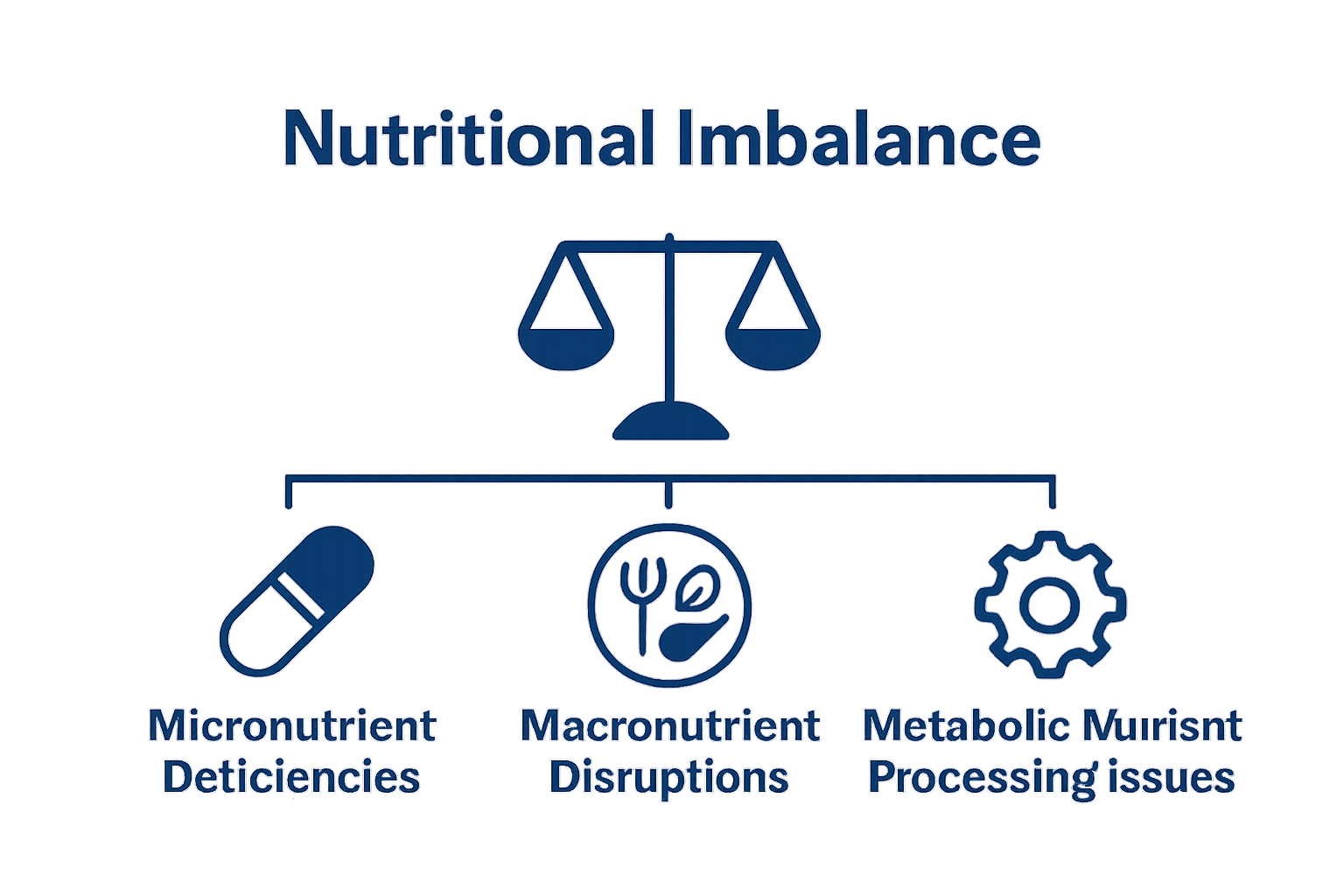
Key Categories of Nutritional Imbalance
- Micronutrient Deficiencies: Insufficient vitamins and minerals
- Macronutrient Disruptions: Improper balance of proteins, carbohydrates, and fats
- Metabolic Nutrient Processing Issues: Challenges in absorbing or utilizing nutrients effectively
Recognizing Common Signs of Nutritional Imbalance
Identifying nutritional imbalance requires careful observation of physical and psychological indicators. Physiological signs may include persistent fatigue, weakened immune response, unusual skin or hair changes, and unexplained weight fluctuations. Cognitive symptoms can involve poor concentration, mood instability, and decreased mental clarity.
Research from Mayo Clinic suggests that these symptoms often develop gradually, making them challenging to recognize immediately. The body compensates for nutritional deficiencies initially, which means early warning signs can be subtle and easily overlooked.
Understanding these signs empowers individuals to take proactive steps toward nutritional wellness, potentially preventing more serious health complications through early intervention and personalized dietary adjustments.
Why Nutritional Imbalance Matters for Your Health
Nutritional imbalance extends far beyond simple dietary concerns, representing a profound health challenge that can significantly impact overall physiological functioning and long-term wellness. When the body experiences sustained nutrient disruptions, the consequences reach well beyond immediate symptoms, potentially triggering complex health complications.
The Systemic Impact of Nutritional Disruptions
Every cellular process in the human body depends on proper nutrient balance. Nutritional imbalances can fundamentally alter metabolic pathways, disrupting critical functions like energy production, immune response, and cellular repair mechanisms. According to Harvard School of Public Health, these disruptions can create cascading effects throughout multiple bodily systems.
Primary Health Systems Affected by Nutritional Imbalance
- Immune system functionality
- Hormonal regulation
- Cognitive performance
- Metabolic efficiency
- Cardiovascular health
Long Term Health Consequences
Prolonged nutritional imbalance transforms from a temporary condition into a potential chronic health risk. Persistent micronutrient deficiencies or excesses can contribute to serious medical conditions such as autoimmune disorders, metabolic syndrome, neurological deterioration, and increased susceptibility to infections.
Research demonstrates that chronic nutritional imbalances can accelerate cellular aging, reduce overall physiological resilience, and create environments conducive to developing serious health complications. The body’s intricate biochemical systems require precise nutrient ratios to maintain optimal performance, and any sustained deviation can trigger progressive health challenges.
Recognizing nutritional imbalance as a critical health determinant empowers individuals to take proactive steps toward comprehensive wellness, implementing strategic dietary interventions that support long-term physiological equilibrium and disease prevention.
How Nutritional Imbalance Affects Your Body’s Functioning
Nutritional imbalance represents a complex biological disruption that fundamentally alters how the human body processes, utilizes, and responds to essential nutrients. When nutrient absorption and metabolism become compromised, the entire physiological system experiences cascading consequences that extend far beyond simple dietary concerns.
Cellular Level Metabolic Disruptions
Nutrient imbalances create profound cellular-level disturbances that interfere with fundamental biological processes. Each cell requires precise nutritional ratios to generate energy, repair damage, and maintain optimal functionality. According to National Institutes of Health, these microscopic disruptions can trigger widespread systemic changes that impact multiple bodily functions.
Key Cellular Processes Affected by Nutritional Imbalance
- Mitochondrial energy production
- Cellular repair mechanisms
- Hormone signal transmission
- Protein synthesis
- Oxidative stress management
Systemic Physiological Response
When nutritional balance is compromised, the body initiates complex compensatory mechanisms to maintain homeostasis. Chronic nutritional imbalances force physiological systems into prolonged stress responses, which can gradually weaken immune defenses, impair metabolic efficiency, and reduce overall physiological resilience.
The endocrine, immune, and nervous systems become particularly vulnerable during sustained nutritional disruptions. Hormonal regulation becomes unstable, immune cell production declines, and neurological communication networks experience reduced efficiency. These interconnected systemic changes demonstrate how deeply nutritional balance influences comprehensive bodily functioning.
Understanding these intricate biological interactions underscores the critical importance of maintaining precise nutritional equilibrium, recognizing that every nutrient plays a strategic role in supporting complex physiological processes and long-term health maintenance.
Key Concepts in Recognizing Nutritional Imbalance
Recognizing nutritional imbalance involves understanding a complex interplay of physiological signals, dietary patterns, and comprehensive health assessments. Nutritional status is not merely about food consumption, but represents a nuanced evaluation of how the body processes, absorbs, and utilizes essential nutrients.
Comprehensive Assessment Parameters
Identifying nutritional imbalance requires a multifaceted approach that goes beyond surface level symptoms. According to the Mayo Clinic, effective recognition involves examining multiple diagnostic indicators that provide insights into an individual’s metabolic and nutritional health.
The following table highlights critical diagnostic indicators for assessing nutritional status and explains their relevance.
| Diagnostic Indicator | Explanation |
|---|---|
| Blood Nutrient Level Testing | Measures specific vitamin and mineral levels in the blood |
| Body Composition Analysis | Evaluates ratios of muscle, fat, and other body tissues |
| Comprehensive Metabolic Panel | Assesses organ function and metabolism-related markers |
| Detailed Dietary Intake Assessment | Examines eating habits and nutritional patterns |
| Physical and Cognitive Evaluation | Monitors signs of deficiency or excess through health checks |
Critical Diagnostic Indicators for Nutritional Status
- Blood nutrient level testing
- Body composition analysis
- Comprehensive metabolic panel
- Detailed dietary intake assessment
- Physical and cognitive functioning evaluation
Understanding Nutritional Markers
Nutritional imbalance manifests through intricate physiological markers that signal potential disruptions in metabolic functioning. These markers extend beyond traditional symptomatic assessments, incorporating advanced diagnostic techniques that reveal underlying nutrient processing challenges.

Specialized biomarkers provide critical insights into an individual’s nutritional landscape, helping healthcare professionals identify subtle imbalances before they develop into more significant health complications. These markers track various metabolic processes, including cellular energy production, immune system functionality, and hormonal regulation.
Comprehensive nutritional assessment requires a holistic approach that integrates multiple diagnostic perspectives, recognizing that nutritional health represents a dynamic and interconnected system of physiological interactions.
Real-World Examples of Nutritional Imbalance Impacts
Nutritional imbalances manifest through diverse and profound health consequences that extend beyond theoretical concepts, revealing tangible impacts on individual and population health. These real-world scenarios demonstrate how nutrient disruptions translate into measurable physiological challenges.
Micronutrient Deficiency Case Studies
Micronutrient deficiencies represent some of the most prevalent and observable nutritional imbalance outcomes. According to World Health Organization, specific nutrient deficiencies create predictable and significant health challenges across different populations and age groups.
Critical Micronutrient Deficiency Examples
- Iron deficiency causing anemia and reduced cognitive performance
- Vitamin D insufficiency leading to bone density problems
- Zinc deficiency impacting immune system functionality
- Vitamin B12 shortage affecting neurological health
- Iodine inadequacy causing thyroid dysfunction
Systemic Health Manifestations
Nutritional imbalances produce complex cascading effects that transform individual nutrient shortages into comprehensive health challenges. When specific nutritional components become disrupted, the body experiences systematic compensatory mechanisms that can trigger long-term physiological adaptations.
Individuals experiencing prolonged nutritional imbalances might encounter progressively complex health challenges. Chronic deficiencies can result in weakened immune responses, metabolic inefficiencies, and increased vulnerability to additional health complications. These real-world scenarios underscore the critical importance of maintaining precise nutritional equilibrium, highlighting how seemingly minor dietary disruptions can generate significant health implications across multiple bodily systems.
Ready to Tackle Nutritional Imbalance with Personalized Insights?
If the signs of nutritional imbalance described above sound familiar—such as persistent fatigue, weak immunity, or unexplained changes in your body—now is the time to take control of your health. Understanding these warning signs is just the first step. Many people struggle to bridge the gap between recognizing symptoms and finding actionable solutions. The truth is, your body’s needs are as unique as you are, and generic advice often falls short.

Discover how Menalam transforms nutritional knowledge into a tangible plan tailored just for you. Take our quick health quiz to receive science-backed supplement and nutrition recommendations based on your individual health profile. Our intelligent platform integrates your lifestyle and, if you choose, your blood test data to ensure your plan adjusts as you progress. Track your supplement intake and health trends easily with our mobile app, while staying consistent with helpful reminders. Do not let vague symptoms hold you back. Visit Menalam now and start making informed choices about your nutrition and wellness.
Frequently Asked Questions
What is nutritional imbalance?
Nutritional imbalance is a health condition where the body does not receive or process nutrients in optimal quantities, leading to either deficiencies or excesses of essential nutrients.
What are the common signs of nutritional imbalance?
Common signs include persistent fatigue, weakened immune response, unusual changes in skin or hair, unexplained weight fluctuations, poor concentration, and mood instability.
How does nutritional imbalance affect the body?
Nutritional imbalance disrupts cellular processes, alters metabolic pathways, and can impact various bodily systems, including the immune, hormonal, and cardiovascular systems.
Why is it important to address nutritional imbalance?
Addressing nutritional imbalance is crucial as it can prevent serious health complications, including autoimmune disorders, metabolic syndrome, and increased susceptibility to infections.
Leave a Reply