


Your daily routine shapes your diet far more than you might think. People with higher education consume 31.5 percent more healthy foods and almost a quarter less unhealthy foods than those with limited schooling. Surprised? Even high-tech food tracking apps have little effect if you are not truly engaged. The way your lifestyle molds your nutrition is about more than just what you eat—it’s about how your habits, connections, and even sleep patterns rewrite the rules of healthy eating.
Table of Contents
- Daily Habits That Influence Nutrition Choices
- Activity Level And Its Impact On Nutritional Needs
- Managing Stress And Sleep For Better Nutrition
- Personalized Nutrition And Science-Backed Supplements
Quick Summary
| Takeaway | Explanation |
|---|---|
| Social connections impact eating habits | Surrounding yourself with individuals who prioritize healthy eating can lead to better dietary choices due to social mirroring. |
| Education enhances nutritional literacy | Higher levels of education correlate with a greater understanding of nutritional information, leading to healthier food choices. |
| Activity level dictates nutritional needs | Understanding your physical activity level is crucial for tailoring your diet, as nutritional requirements vary significantly between sedentary and highly active individuals. |
| Stress and sleep affect nutrition | There is a complex relationship between stress, sleep quality, and dietary decisions, where poor sleep can lead to unhealthy eating, and stress can trigger cravings for comfort foods. |
| Personalized nutrition is the future | Advances in science and technology allow for customized dietary recommendations based on individual genetic and metabolic profiles, making one-size-fits-all approaches less effective. |
Daily Habits That Influence Nutrition Choices
Nutrition is not just about what you eat but how your daily lifestyle and habits shape your food choices. Every decision you make throughout the day can significantly impact your dietary patterns, creating a complex web of influences that determine your overall nutritional intake.
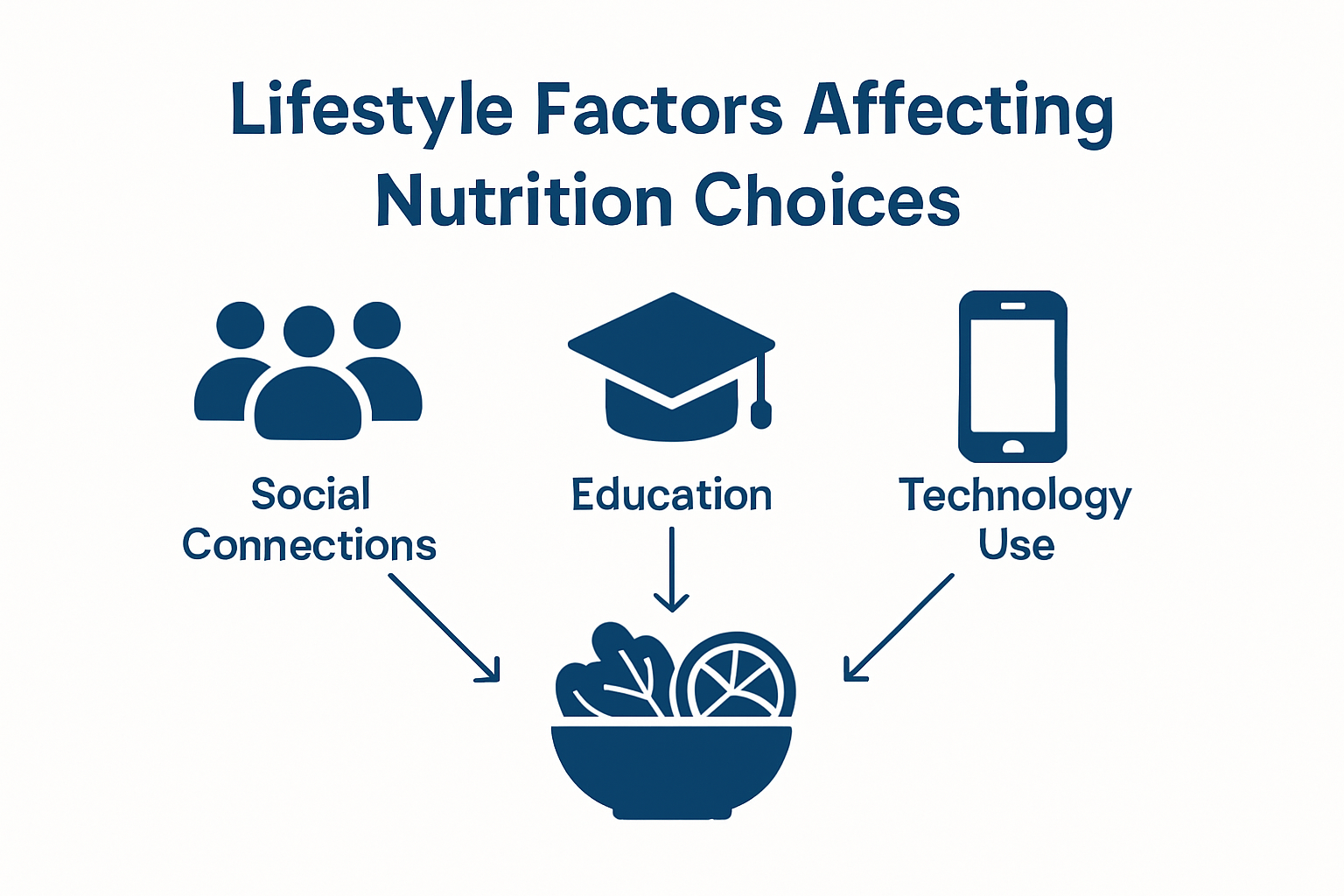
Social Connections and Eating Behaviors
Your social environment plays a profound role in shaping nutritional choices. A groundbreaking study from the École Polytechnique Fédérale de Lausanne revealed that social connections dramatically influence eating habits. Research demonstrated that individuals who regularly dine with partners making healthier food choices significantly improved their own dietary patterns.
People tend to unconsciously mirror the eating behaviors of those around them. This social mirroring occurs in multiple contexts workplace lunch rooms, family dinners, and social gatherings. When surrounded by individuals who prioritize nutritious foods, you are more likely to make similar choices. Conversely, being in environments where processed and unhealthy foods are prevalent can lead to less optimal nutritional decisions.
Education and Dietary Awareness
Education emerges as a critical factor in understanding and implementing healthier nutrition choices. A comprehensive study utilizing the Indonesian Family Life Survey provides compelling evidence. Research findings indicated that individuals with upper secondary or higher education levels consumed 31.5% more healthy foods and 22.8% less unhealthy foods compared to those with lower education levels.
Higher education typically correlates with increased nutritional literacy. People with advanced educational backgrounds are more likely to:
- Understand nutritional labels
- Recognize the long term health implications of dietary choices
- Have access to reliable health information
- Develop critical thinking skills about personal nutrition
Here’s a table summarizing how education level impacts healthy and unhealthy food consumption based on the research mentioned above:
| Education Level | Healthy Food Consumption | Unhealthy Food Consumption |
|---|---|---|
| Upper Secondary or Higher | +31.5% | -22.8% |
| Lower Education | Baseline | Baseline |
Digital Tracking and Mindful Eating
In the digital age, food tracking applications have emerged as potential tools for nutritional awareness. However, their effectiveness is nuanced. An analysis of MyFitnessPal data revealed that while food journaling is intended to promote mindful eating, active users’ dietary habits often closely resembled those of the general population.
This suggests that merely logging food intake does not automatically translate to healthier choices. Successful nutritional transformation requires active engagement, understanding personal patterns, and making conscious decisions. Digital tools can provide insights, but they are most effective when combined with intentional lifestyle modifications.

Understanding how daily habits influence nutrition is the first step toward creating meaningful dietary changes. By recognizing the complex interplay of social connections, education, and personal awareness, you can develop a more strategic approach to your nutritional journey. The key lies not in perfection but in consistent, informed choices that gradually reshape your relationship with food.
Making sustainable nutritional changes starts with small, deliberate steps. Observe your current habits, understand their origins, and gradually introduce healthier alternatives. Your daily choices are powerful tools in crafting a more nutritious lifestyle.
Activity Level and Its Impact on Nutritional Needs
Your physical activity level is a critical determinant of your nutritional requirements. Different levels of movement and exercise fundamentally alter how your body processes nutrients, metabolizes energy, and maintains overall health. Understanding this relationship helps create more personalized and effective nutrition strategies.
Physical Activity and Metabolic Demands
Physical activity dramatically transforms nutritional needs. Research from the National Institutes of Health indicates that individuals engaged in strenuous work require significantly higher energy intake compared to those maintaining sedentary lifestyles. The metabolic demands of physical activity create a complex interplay between movement and nutritional requirements.
For instance, athletes and individuals with high-intensity workout routines need substantially more calories and specific macronutrient ratios to support muscle recovery and energy replenishment. A sedentary office worker might require approximately 2000 calories daily, while a professional athlete could need up to 4000 calories to maintain optimal performance and body composition.
The table below compares daily calorie needs and nutritional focuses for different physical activity levels as described in the text:
| Activity Level | Estimated Daily Calories | Nutritional Focus |
|---|---|---|
| Sedentary Office Worker | ~2,000 | Calorie control, micronutrient optimization |
| Professional Athlete | Up to 4,000 | Higher protein and carbs, energy replenishment |
| Moderate Exercise/General Fitness | ~2,000–2,500 | Balanced macronutrient approach |
Age Related Activity and Nutritional Adaptation
Activity levels change across different life stages, necessitating corresponding nutritional adjustments. A comprehensive study published in PubMed revealed that higher physical activity levels are associated with improved anthropometric indicators, enhanced physical fitness, and more balanced lipid profiles among older adults.
Adolescents present another fascinating case study. Research from comprehensive health databases demonstrated that increased physical activity at school positively correlates with maintaining normal body mass index (BMI) and developing healthier nutritional behaviors. This underscores how movement during formative years can establish lifelong metabolic patterns.
Nutrient Requirements and Exercise Intensity
Not all physical activities demand identical nutritional support. The intensity, duration, and type of exercise significantly influence specific nutrient requirements. Endurance athletes might need higher complex carbohydrate intake, while strength training individuals require more protein for muscle repair and growth.
Key nutritional considerations vary based on activity levels:
- Intense Cardio: Higher carbohydrate and electrolyte needs
- Strength Training: Increased protein consumption
- Moderate Exercise: Balanced macronutrient approach
- Sedentary Lifestyle: Calorie control and micronutrient optimization
Understanding your unique activity profile allows for precise nutritional customization. This personalized approach ensures that your diet supports your specific physical demands, whether you are a professional athlete, weekend warrior, or someone maintaining general fitness.
Recognizing the dynamic relationship between physical activity and nutrition empowers individuals to make informed dietary choices. Your body is not a static system but a responsive mechanism that adapts to movement, stress, and energy expenditure. By aligning your nutritional intake with your activity level, you create a powerful synergy that supports optimal health, performance, and well being.
Managing Stress and Sleep for Better Nutrition
Stress and sleep are interconnected factors that profoundly influence nutritional behaviors and overall health. The intricate relationship between these elements creates a complex cycle that can either support or undermine your dietary wellness goals.
The Hormonal Impact of Stress on Nutrition
Research from George Mason University reveals that elevated stress levels trigger the release of hormones like cortisol, which can dramatically disrupt sleep patterns and lead to unhealthy dietary habits. This creates a detrimental feedback loop affecting both physical and mental well-being.
When stress hormones surge, individuals often gravitate toward comfort foods high in sugar and saturated fats. These nutritional choices provide temporary emotional relief but ultimately contribute to metabolic imbalances. The body enters a state of physiological stress response, where normal hunger regulation mechanisms become compromised, leading to increased cravings and potential overeating.
Sleep Quality and Dietary Choices
A comprehensive study from Bowling Green State University highlighted that insufficient or poor-quality sleep directly correlates with increased food cravings and suboptimal dietary decisions. College students experiencing high financial stress demonstrated particularly notable shifts in their nutritional behaviors.
Interestingly, nutritional research published in medical journals suggests that dietary composition can significantly influence sleep quality. Diets rich in fiber, fruits, vegetables, and anti-inflammatory nutrients, while lower in saturated fat, are associated with improved sleep patterns. This indicates a bidirectional relationship where nutrition can both impact and be impacted by sleep.
Strategies for Nutritional Resilience
Breaking the stress-sleep-nutrition cycle requires a holistic approach. Implementing targeted strategies can help restore balance and support overall wellness:
- Mindful Eating: Practice conscious consumption, focusing on nutrient-dense foods
- Stress Reduction Techniques: Incorporate meditation, deep breathing, or yoga
- Consistent Sleep Schedule: Maintain regular sleep and wake times
- Nutrient-Dense Evening Meals: Choose foods that support relaxation and sleep
Understanding that stress, sleep, and nutrition are deeply interconnected empowers individuals to make more intentional lifestyle choices. By recognizing how these elements influence each other, you can develop a more comprehensive approach to health that goes beyond traditional dietary recommendations.
Your nutritional journey is not just about what you eat, but also about how you manage stress and prioritize rest. Creating harmony between these aspects allows your body to function optimally, supporting metabolic efficiency, emotional balance, and long-term wellness. Small, consistent changes in your approach to stress, sleep, and nutrition can yield profound improvements in your overall quality of life.
Personalized Nutrition and Science-Backed Supplements
The landscape of nutrition is rapidly evolving, moving beyond one-size-fits-all approaches toward highly individualized dietary strategies. Personalized nutrition represents a groundbreaking frontier where science, technology, and individual health data converge to create tailored nutritional recommendations.
The Science of Precision Nutrition
The National Institutes of Health has invested $170 million in the Nutrition for Precision Health program, signaling a transformative approach to understanding individual dietary needs. This initiative aims to develop sophisticated algorithms capable of predicting personal responses to different diets by analyzing complex interactions between diet, genes, proteins, microbiome, and metabolism.
Precision nutrition goes beyond traditional dietary guidelines by recognizing that each person’s genetic makeup, metabolic profile, and lifestyle create a unique nutritional fingerprint. What works optimally for one individual might not provide the same benefits for another. This personalized approach considers multiple factors including genetic predispositions, metabolic responses, gut microbiome composition, and individual health goals.
Emerging Technologies in Nutritional Customization
Research from the University of Illinois Urbana-Champaign has established comprehensive guidelines for personalized nutrition. These guidelines emphasize the critical importance of integrating diverse data types while maintaining rigorous ethical standards for data collection and interpretation.
Cutting-edge technologies now enable unprecedented levels of nutritional customization. Advanced genetic testing, metabolic profiling, and artificial intelligence algorithms can now generate nutrition plans that are remarkably precise. These technologies analyze multiple data points to recommend specific dietary interventions, supplement strategies, and lifestyle modifications tailored to an individual’s unique physiological characteristics.
Selecting Science-Backed Supplements
The Precision Nutrition Forum at Harvard T.H. Chan School of Public Health continues to push boundaries in understanding how targeted supplementation can address individual nutritional gaps. Not all supplements are created equal, and the key lies in selecting evidence-based options that align with specific health needs.
Key considerations for choosing science-backed supplements include:
- Molecular Compatibility: Supplements that match individual genetic profiles
- Bioavailability: Ensuring efficient absorption and utilization
- Third-Party Testing: Verified quality and purity standards
- Targeted Health Outcomes: Supplements addressing specific physiological requirements
The table below summarizes the key considerations for selecting science-backed supplements as outlined above:
| Consideration | Description |
|---|---|
| Molecular Compatibility | Matched to individual genetic profiles |
| Bioavailability | Efficient absorption and utilization |
| Third-Party Testing | Verified for quality and purity standards |
| Targeted Health Outcomes | Addresses specific physiological requirements |
The future of nutrition is deeply personalized, recognizing that health is not a universal concept but a highly individual experience. By leveraging advanced scientific methodologies, individuals can now access nutrition strategies that are as unique as their own genetic blueprint.
Embrace the potential of personalized nutrition not as a passing trend, but as a scientifically sophisticated approach to understanding and optimizing your health. Your nutritional journey is a dynamic, evolving process that requires continuous learning, adaptation, and a commitment to understanding your body’s distinctive needs.
Frequently Asked Questions
How does my social environment impact my nutrition?
Your social connections play a significant role in shaping your eating habits. When you associate with individuals who prioritize healthy eating, you’re more likely to make better dietary choices due to social mirroring.
Why is education important for understanding nutrition?
Higher levels of education are linked to better nutritional literacy. Individuals with advanced education tend to have a greater understanding of nutritional information, leading to healthier food choices.
How does physical activity level influence dietary needs?
Your physical activity level greatly affects your nutritional requirements. Sedentary individuals typically need fewer calories than those who engage in regular exercise or high-intensity workouts, which demand higher energy intake and specific nutrient ratios.
How do stress and sleep affect my dietary decisions?
Stress and sleep are interconnected factors that can influence your nutritional choices. Poor sleep can lead to unhealthy eating behaviors, while elevated stress often results in cravings for comfort foods high in sugar and fats.
Start Your Real Personalized Nutrition Journey with Menalam
Feeling overwhelmed by the endless nutrition advice and frustrated that generic diets do not account for your unique habits, stress, or changing activity? As this article made clear, real change comes from understanding how your lifestyle, social circles, education, and even sleep patterns shape your nutritional needs. Yet, translating all that insight into action is tough—especially when one-size-fits-all approaches fail to address you as an individual.
It is time to move beyond guesswork. Menalam leverages cutting-edge artificial intelligence to analyze your health profile, lifestyle, and even your daily challenges to deliver personalized supplement plans backed by science. Take our quick health quiz, and you will instantly receive recommendations that adapt as your life evolves. Experience true customization, ongoing plan adjustments, and smart reminders—so you never have to second guess your path to better health. Make your nutrition fit your life. Visit Menalam now and let your journey to genuine personalization begin.
Leave a Reply